As author James Fallows puts it: “noise is the secondhand smoke of the era.”
“Nearly everything about how Americans “care” for their lawns is deadly.”
– Margret Renkl
Customers also have to adapt to a changing climate and manage their expectations about what truly makes a yard “clean.”
While some outdated aesthetics (think big box store ads and stock photos from the 2000s) imply that a clean yard is free from the chaos of any natural processes, many Americans are starting to see lawns in a new light—and realizing that the traditional idea of a “good” lawn (neatly mowed, weed-free, and bright green) often comes at a high ecological cost. What was once a symbol of care and pride now stands for wasteful ignorance and a lack of respect for our place in the natural world. Now, we it’s becoming more commonplace to understand that biodiversity, and native plantings actually reflect deeper care—for pollinators, for soil health, and for our shared future. The real moral value lies in embracing nature, not controlling it. A truly clean yard is one that has a closed loop of nutrient cycling. This is only one of the reasons almost 200 municipalities have banned gas leaf blowers across the country in an effort to move the needle toward more ecological landscape practices.
Non-native turf grass is the dirtiest choice for ground cover because of the chemical, mechanical, financial, and time-intensive inputs required to keep it short and green. Most people truly have no idea that Kentucky bluegrass has nothing to do with Kentucky.
“First, their environmental and climate impacts are horrific. This technology relies on a combustible mix of oil and gas. A typical leaf blower reportedly burns just 60 percent of its fuel—the rest is spewed into the atmosphere. The two-stroke gas engines that power most leaf blowers use is an antiquated technology that has been phased out in nearly all areas—except yard work.”
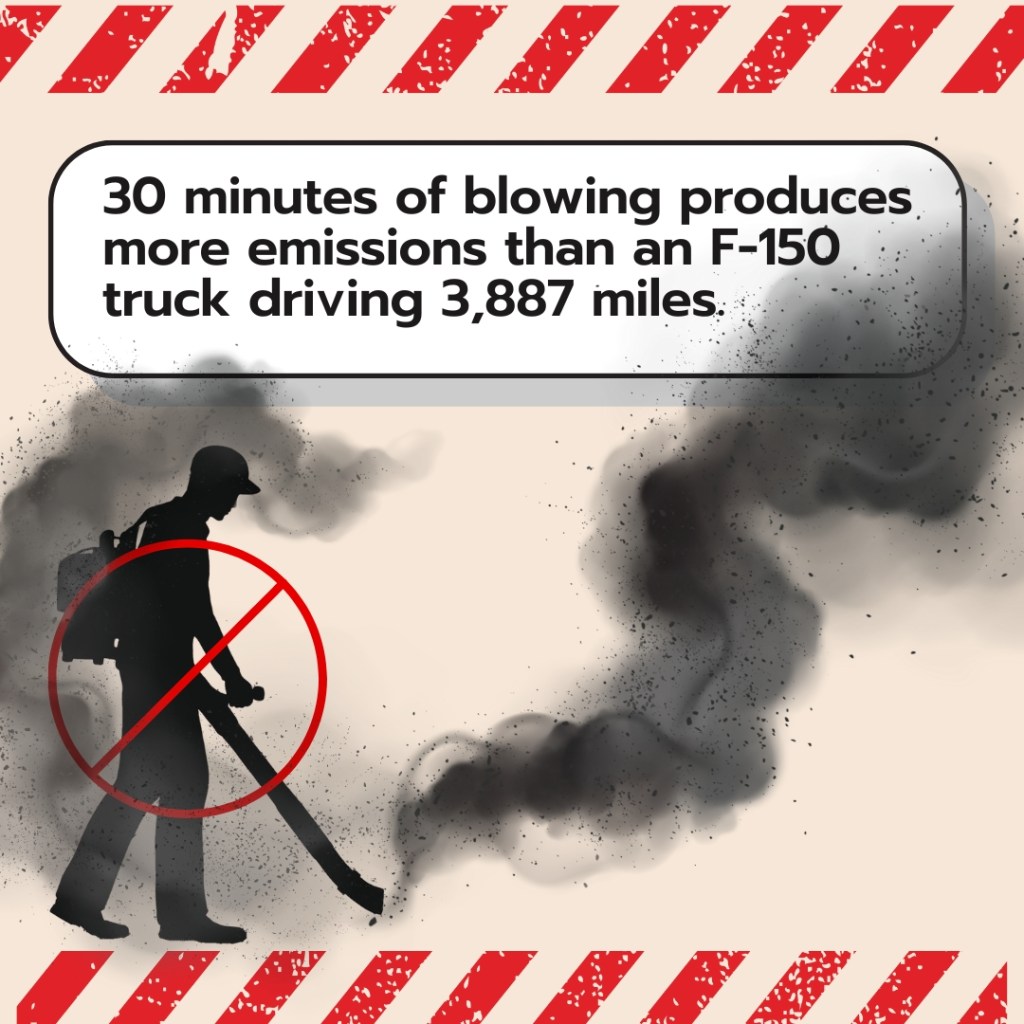
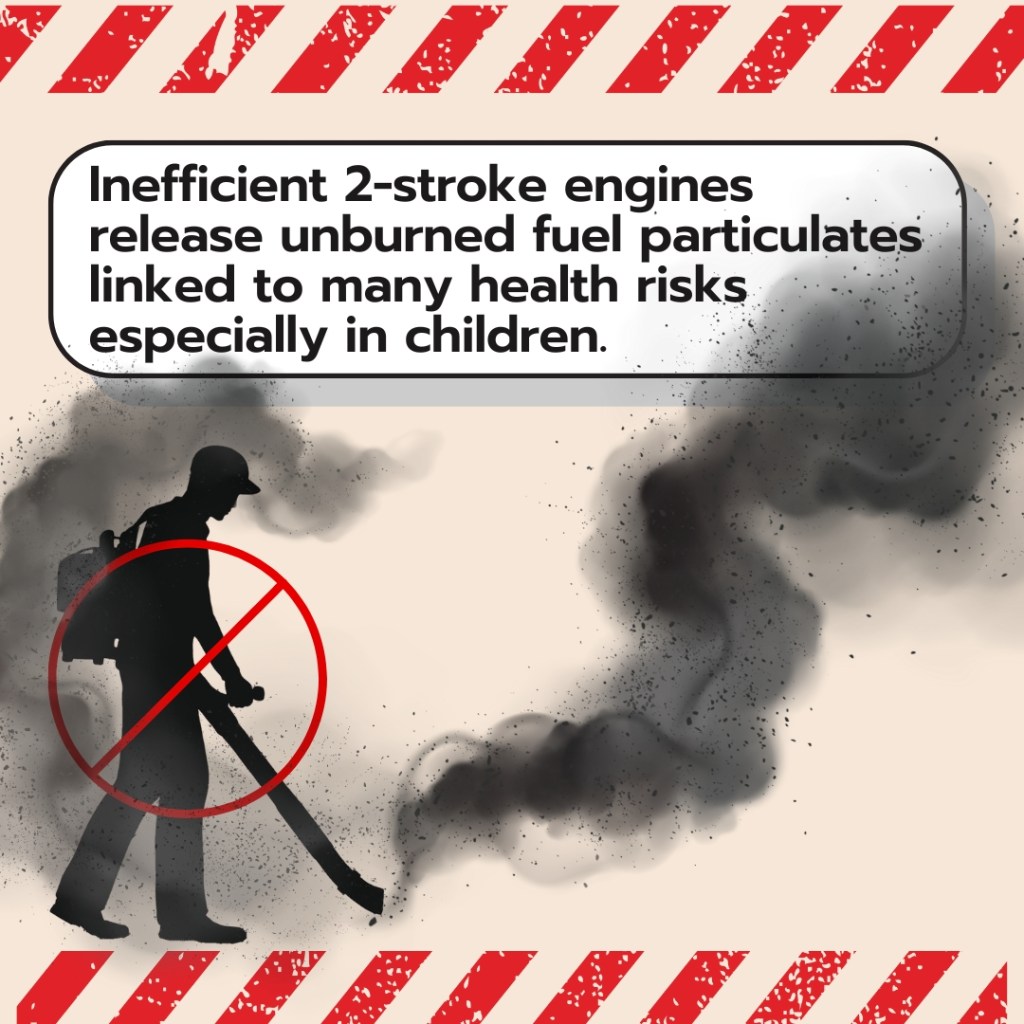
Primitive 2-Stroke engines fail to combust 30% of their fuel which is released as fine particulates along with carcinogens like benzene, VOCs, and formaldehyde. Gas leaf blowers produce an excessive 2-4 pounds of particulates per hour that can lodge deep in your lungs and enter the bloodstream – especially harmful to lung development in children. For comparison, an efficient wood burning stove produces .04 grams of particulates per hour. According to an Edmonds study, gas leaf blowers produce more pollution in one hour of operation than an F-150 truck traveling 3,900 miles.
Extreme winds of 200 mph (category 5 hurricane strength) blast pollen, heavy metals, dried animal feces, mold, allergens, pesticides, and dirt into the air remaining airborne for hours and clinging to window screens and other surfaces. Removing organic matter increases runoff and destroys soil’s ability to sequester carbon, depletes soil health, destroys microbial life and beneficial insects.
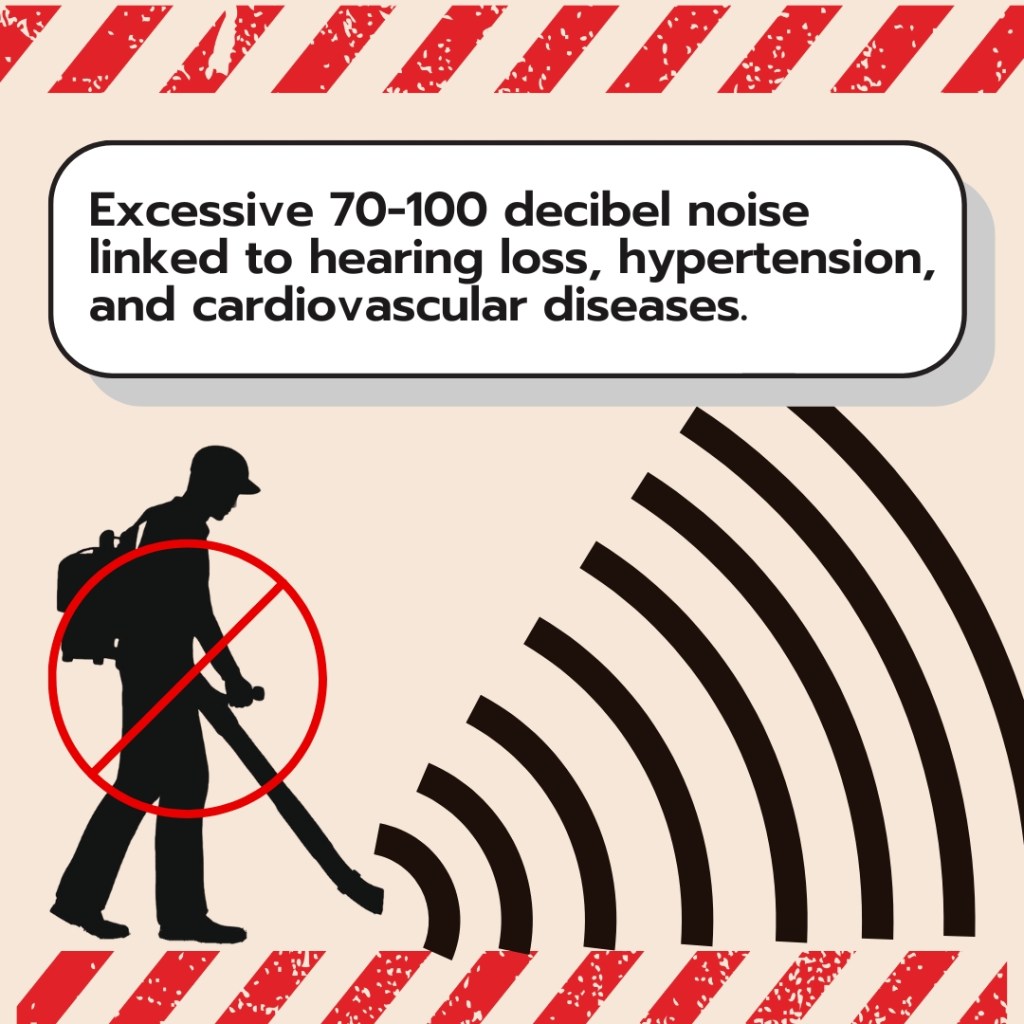
Low Frequency Noise penetrates neighbors’ walls and windows disrupting work, concentration, waking children from naps, causing stress, and imposing on your neighbors’ right to a peaceful soundscape. travels farther – up to half a mile – typically affecting 90 neighbor’s homes. Extreme noise between 70-100 decibels is known to cause permanent hearing loss, high blood pressure, hypertension, and cardiovascular disease.
Maryland Code Environment § 3-102: “That the people of this State have a right to an environment that is free from any noise that: May jeopardize their health, general welfare, or property; or Degrades the quality of their lives. That there is a substantial body of knowledge about the adverse effects of excessive noise on the public health…”
“Analyzing U.S. Environmental Protection Agency data, the report found that gas-powered lawn and garden equipment in Maryland emitted an estimated 597 tons of harmful ‘fine particulate’ air pollution in 2020 — an amount equivalent to the pollution emitted by 6.4 million gas-powered cars over the course of a year.”
The slippery slope argument which begs the question “what will they ban next?” is often a last ditch distraction from vast amounts of data that prove the disastrous level of harm caused by gas leaf blowers. Similar push back came from cigarette companies, lead paint companies, and chemical companies that required legislative interference to change the industry standard and public opinion. The freedom argument is often brought up in reaction to regulation of gas leaf blowers. Limiting one’s ability to pollute and do harm is a not a threat to freedom. The freedom we should be defending it the right to live free of harm. Is one person’s freedom to pollute more important than their neighbor’s freedom to breathe clean air and live in peace inside their own homes?
Charging Batteries
Some argue that landscaping crews will have the extra burden of purchasing and continually charging batteries. A local article suggested the that they will have to carry a diesel generator to charge the batteries they have to take to job sites. Another suggested that batteries are more flammable than the cans of gasoline and oil that they have to lug around from site to site, which shows how far the defense has to go to drum up support for keeping these machines in circulation.
There are many ways to offset the need to charge batteries:
supplemental use of rakes
voucher programs that offer rebates for the purchase of more batteries
curtailing the excessive/wasteful use of blowers
leaving some organic matter in garden beds and as mulch under trees and shrubs
educating customers on the cost saving benefits of leaving the leaves
The default state of the industry for land management and lawn care is an existential threat. The use of outsized machinery to remove all organic material from a yard should not be the industry standard given all the data of the environmental damage it causes. Mowing a small urban lawn with an industrial riding mower that churns out 100 decibels and the equivalent emissions of 30 cars, on a weekly basis is wildly out of proportion for the task.
The Way We “Care” for our Yards Need to Change
“The EPA estimates that the impact of one pound of nitrous oxide on warming the atmosphere is almost 300 times that of an equivalent pound of carbon dioxide. Professor Karen Jubanyik at Yale School of Medicine has astutely noted that lawn equipment may become one of the country’s largest sources of pollution.”
“Data from the Environmental Protection Agency’s 2020 National Emissions Inventory… found that (lawn) equipment released more than 68,000 tons of smog-forming nitrous oxides, which is roughly on par with the pollution from 30 million cars. Lawn equipment also spewed 30 millions tons of climate-warming carbon dioxide, which is more than the total emissions of the city of Los Angeles.”
Opponents of the ban argue that electric leaf blowers are much more expensive than gas. They are in fact much cheaper to operate and maintain in the long run with an up-front cost that is around the same as their gas counterparts depending on the cfm (cubic feet per minute). 2-stroke engine technology has been banned and phased out in every field of use except for landscaping. Battery equipment technology has advanced considerably.
It’s important to emphasize that the end goal of restrictions on gas blowers is to raise awareness about the damage our lawn care regimen has on human health and the environment. It also serves to spark a shift in customer demand toward a landscape that works with natural processes rather than supplant them with chemicals and unnecessary perpetual maintenance.
But It Will Take Twice as Long to Clean my Yard!
Crews are often instructed to spend an exact amount of time on a property regardless of the work to be done. Often, with multi person crews, the work becomes performative. Blowing leaves into the street or neighboring properties, out of wooded areas and back again, or out of garden beds of pachysandra and then into the street. It is mind boggling how futile this “work” has become just because this tool gives the perception of work being accomplished.
Crews are often dispatched to blow through multiple houses on the same street, marching down the block and making excessive noise at unpredictable intervals throughout the entire day. Often, multiple crews from different landscaping companies visit multiple houses throughout the entire day creating an unacceptable, unpredictable disturbance with both excessive noise and exhaust.
Enforcement
In Annapolis, enforcement of the leaf blower ban falls to the Police Department the same way reporting any kind of environmental or societal harm is reported. If someone is dumping motor oil in the storm drains, it is the jurisdiction of the Police Department to handle similar infractions that cause environmental harm as a matter of deterrence.



 Promoting peaceful, healthy communities in Annapolis, MD.